





Modernizing OPM and Reimagining the Federal Workforce
Submitted by MKeegan on Mon, 03/23/2026 - 13:39
Thursday, March 19, 2026
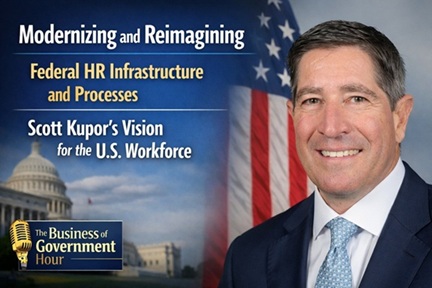
There's a phrase that circulates quietly among federal human capital professionals — one that Scott Kupor, Director of the U.S. Office of Personnel Management, dropped early in our conversation on The Business of Government Hour. OPM, he told me, had long been called "no PM" not OPM” by the agency heads he visited when he first arrived. The nickname stung, but it also clarified. It told Kupor everything he needed to know about the organization's reputation, and more importantly, about the distance between where OPM was and where it should be. "I would like to think of us as go PM," he said, "and not no PM."
That small verbal pivot captures something essential about how Kupor operates. Given its stated mission, OPM on some level is one of the most consequential, and most misunderstood, agencies in the U.S. federal government. It sits at the center of the workforce enterprise for roughly two million civilian employees. It manages federal health and retirement programs, oversees the hiring process that routes talent across every corner of government, and sets the policy frameworks shaping how that talent is developed, evaluated, and retained. This mission scope is extraordinary, and the challenges faced are equally so: turning a policy-heavy bureaucracy into a genuine service and strategy partner, while modernizing systems that have spent decades accumulating inertia, during a period of significant government-wide workforce disruption. The following essay offers insights from my recent conversation with Scott Kupor.
The Demographic Wake-Up Call
Before any conversation about technology or process improvement goes very far, the numbers demand attention. OPM, as Kupor sees it, is at a genuine turning point. Demographics, technology, and fiscal pressure are all converging at once.
The numbers tell part of the story. Only about 7 percent of federal employees are under 30. In the broader labor market, that figure is closer to 22 percent. At the same time, nearly 44 percent of federal workers are over 50.
That imbalance isn’t just a workforce issue; it’s a strategic one. Without deliberate action, the government risks losing institutional knowledge faster than it can replace it. According to Kupor, the federal government's pitch to early career workers has been badly miscalibrated. Young people today, including his own children think in two- or three-year increments. They're not looking for a forty-year career arc.
Kupor’s response isn’t to double down on the traditional pitch. Instead, he reframes the value proposition entirely.
Kupor wants to rewrite that message: come for two years, work on genuinely hard problems, serve the public, and if you love it, stay. If you want to explore the private sector, that's not a failure — it's a feature.
It’s a subtle shift, but an important one. In today’s labor market, Kupor notes that relevance depends less on permanence and more on permeability and making it easier for people to move in and out of government over the course of their career
Attracting younger talent into government, though, is only half the problem. The other half is what actually happens to them once they arrive.
Rewiring the Incentive Structure
Kupor returns often to the idea of a high-performance culture. He spent most of his career in venture capital and that experience shapes how he reads organizational behavior. For him, it comes down to incentives. Organizations are simply groups of people responding to the signals around them.
If excellence isn’t recognized or underperformance isn’t addressed, then Kupor asserts that mediocrity becomes the default.
He notes that roughly 99.7 percent of federal employees receive ratings of “meets expectations” or higher. At that level, differentiation disappears and without differentiation, performance management becomes little more than a formality. He isn’t criticizing individuals. His concern is structural. For Kupor, too much of the system relies on proxies, time in grade, credentials, tenure, rather than demonstrated capability.
This creates problems on both ends. High performers don’t feel recognized and organizations lack effective tools to deal with persistent underperformance. His solution is straightforward, even if it’s disruptive: align hiring, promotion, and pay with actual performance: not potential, not tenure, but performance Kupor underscores.
He says that if a 22-year-old can operate at a GS-14 level, the system should be able to recognize that without forcing them to wait years to “earn” it. To Kupor this represent merit in its purest form. For him adopting it at scale would mark a significant departure from how federal talent systems have traditionally worked.
Fixing the Front Door
Hiring is where these ideas become tangible.
Today’s process is fragmented, slow, and often out of sync with how candidates actually experience the job market.
The average time to hire in the federal government — from the moment an applicant expresses interest to the day they start — has hovered around 101 days. Executive Order 14170 set a target of eighty days.
This isn’t just about speed. It’s about rethinking the process from the applicant’s point of view.
That starts with the front end: making USAJobs easier to navigate, simplifying applications, and moving away from self-reported qualifications toward more reliable skills-based assessments.
However, the more interesting idea is what he calls “shared certificates.”
The idea: conduct centralized assessment and screening through OPM, then share pools of qualified candidates across agencies simultaneously.
Instead of making applicants navigate 150 different agency websites and job postings, USAJobs would surface relevant opportunities based on skills profiles and route candidates accordingly. Agencies, meanwhile, would compete for that talent on the quality of their interview process and the strength of their pitch — a dynamic Kupor believes will improve the candidate’s experience and drive down time to hire.
The back end of the process that stretch between offer and first day is where security reviews and background investigations add another thirty to ninety days. OPM is working with the Defense Counterintelligence and Security Agency to figure out which steps can be started earlier, and which can run in parallel rather than sequentially. The goal, as Kupor put it, is to streamline—using parallel processing and risk-based approaches to move faster without compromising security.
The through line for Kupor is consistent: reduce friction, increase transparency, and treat applicants like customers rather than obstacles.
Building Systems That Actually Learn
One of the more illuminating threads in our conversation was Kupor's account of OPM's Online Retirement Application, or ORA. More than 120,000 people have already moved through it — a meaningful shift from the paper-intensive, processing-lag-prone retirement workflows that have frustrated employees and administrators for years. But what made ORA instructive was less the product itself than the development philosophy behind it.
Kupor borrowed directly from startup practice: build a minimum viable product, get it into users' hands fast, gather feedback, and iterate. He told HR stakeholders upfront that the initial release wouldn't be perfect. That transparency was deliberate. In his experience, the reason large government technology projects fail almost always comes down to the same thing — organizations spend so long trying to anticipate every possible requirement that by the time they release anything, real-world usage bears little resemblance to what was designed in the conference room.
The same logic drove the Federal Workforce Database, or FWD, which replaced the older FedScope platform. The launch blog post acknowledged plainly that it was a work in progress. That kind of honesty about an unfinished government system is rarer than it should be. For Kupor the point is to learn, not to pretend completeness.
His broader data strategy flows from the same principle. OPM's goal is to be a single canonical source of workforce data — a data lake — accessible through customized reporting interfaces that give agencies real-time visibility into their own performance.
Hiring rates, performance management compliance, merit hiring adherence: all of it tracked, visible, and shared in the form of a monthly leaderboard sent to agency heads. Not as an audit, Kupor was careful to say, but as a management tool. If an agency is lagging, OPM wants to ask how it can help — not flag a violation.
Moving Beyond Credentials to Skills
One of the more ambitious elements of Kupor’s agenda is the shift to skills-based hiring.
Right now, the federal system includes more than 600 job classifications—many tied to degrees or years of experience. In practice, those requirements often serve as blunt instruments. They don’t always reflect what someone can actually do.
Kupor wants to change that, starting with fields like IT.
It’s a massive undertaking, but to Kupor it’s also necessary if government wants to compete for talent in fast-moving sectors where traditional credentials matter less and less.
That’s not just modernization, It’s a fundamentally different way of thinking about how workforce systems should function.
Rethinking Risk in the Age of AI
Until a few months before our conversation, federal employees at OPM didn't have access to AI tools like ChatGPT on government devices. The security concerns were legitimate, he acknowledged. But the response to those concerns had been disproportionate. Vendors had already built government-specific instances of their platforms addressing the core data and privacy requirements. What held back deployment wasn't technical reality; it was organizational reflex. The instinct to gate, restrict, and require four-page usage agreements before letting anyone near something new. Government, he notes, tends to operate with a “do no harm” mindset. That’s understandable, but it can also slow innovation.
Kupor’s views on AI reflect a broader philosophy about risk. Assess risk realistically then weigh potential downsides against potential benefits. Kupor stripped it down to two things that actually mattered: remind people that these tools hallucinate and therefore require human verification and then trust them to do their jobs.
More broadly, Kupor frames AI as something employees need to engage with. Not just for the organization’s sake, but for their own long-term relevance.
It’s a shift in tone. AI isn’t positioned as a threat to jobs, but as a tool—one that rewards those willing to adapt.
Efficiency, Properly Understood
Efficiency comes up repeatedly in Kupor’s thinking, but not in the way it’s often framed.
He’s not talking about cutting costs for the sake of it. His definition is more precise: delivering the same or better outcomes at equal or lower cost.
That distinction matters. It rejects the idea that efficiency and effectiveness are in tension. In Kupor’s view, they should reinforce each other.
One example is the relationship between federal employees and contractors. By looking at both through a single budget lens, agencies can better understand their total workforce costs and make smarter decisions about how to allocate work.
It also changes incentives. If leaders are measured only on headcount, they’ll shift work to contractors. If they’re measured on total cost and performance, they’re more likely to optimize for long-term value.
That’s a recurring theme in my conversation with Kupor: change the incentives, and behavior follows.
A More Adaptive Model of Government
Step back, and what emerges isn’t a single reform. It’s a broader philosophy.
It starts with people—how they’re hired, developed, and motivated. It embraces technology as a tool, not an end. It treats constraints not as barriers, but as catalysts for change.
Execution, of course, is the hard part. Changing incentives, modernizing systems, shifting culture and none of that happens quickly. Real change doesn’t come from sweeping declarations. It comes from adjusting how things work day to day:
Fix the hiring process. Rethink performance metrics. Deploy technology differently. Expand how leaders gain experience.
Taken together, those steps begin to add up.
The Longer Horizon
When I asked Kupor what he thought the federal workforce would look like in 2030 his response was frank. He said he had no idea and anyone claiming to know was probably fooling themselves. What he does believe is that technological progress will keep accelerating, that the organizations that thrive will be those with cultures built to adapt.
He offered a vision he'd be content with a steady stream of young people spending two years in government service before heading to the private sector, perhaps returning a decade later with new skills and different perspectives. A Senior Executive Service whose members are required to spend time outside government as part of their development path and not as an exception but as a standard.
Getting from here to there will take some doing. A hundred and nineteen separate HR IT systems need to be consolidated into something coherent. Forty-six thousand HR professionals scattered across agencies, working at roughly half the efficiency ratio common in comparably sized private organizations, need new tools and a fundamentally different operating model. The retirement system still handles too much on paper. The hiring portal still loses qualified candidates to process friction.
The problems are large. They aren't mysterious. Kupor wants the agency to matter and be useful. In that light, the move from “no PM” to “go PM” isn’t just a slogan. It’s a challenge—to rethink not only what government does, but how it does it.