





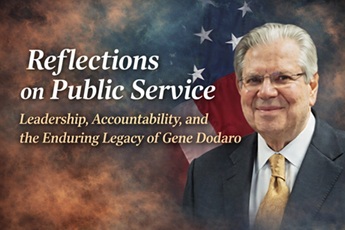
Serving as the eighth Comptroller General of the United States and head of the Government Accountability Office (GAO) from 2010 until December 29, 2025, Gene Dodaro capped a remarkable 50-year career with an institution synonymous with fiscal integrity and governmental reform.
His tenure coincided with some of the most consequential and destabilizing moments in modern American governance: the global financial crisis, the Great Recession, the COVID-19 pandemic, intensifying cyber and infrastructure threats, and mounting fiscal pressures driven by demographics and healthcare costs. Through each of these challenges, GAO remained a trusted, nonpartisan institution—an outcome that was neither accidental nor inevitable, but the product of deliberate leadership choices grounded in accountability, professionalism, and respect for public servants.
In the closing weeks of his 15-year statutory term as Comptroller General, Gene joined me on The Business of Government Hour for a final, reflective conversation on public service, his extraordinary career spent strengthening government performance, elevating public accountability, and building the foundation for a more resilient federal enterprise.
His insights offer both a testament to effective leadership in turbulent times and a roadmap for the persistent challenges ahead
"It's been just an absolute privilege to lead the people of the GAO, to serve the Congress, to serve the country, to be able to work on the most important national issues, and make a difference for the American people," Dodaro reflected, capturing the essence of his dedication.
A Leadership Philosophy Rooted in People and Communication
Throughout his tenure, Dodaro maintained an unwavering focus on what he calls the foundation of effective organizational leadership: people, communication, and trust. "I'm a great believer in communication," Dodaro explained, emphasizing that leaders must have "a good vision of what needs to be done, be able to communicate that effectively and work in partnership with the people that you are leading." But communication alone isn't enough—it must be grounded in genuine relationships built on mutual respect and clear expectations.
What distinguished Dodaro's approach was his deliberate cultivation of what he termed "people values" alongside GAO's traditional institutional values of nonpartisanship, independence, and fact-based analysis. "I thought we needed to strengthen our commitment to one another as professionals," he noted, ensuring that "everybody in GAO feels valued, respected and treated fairly." This wasn't merely aspirational rhetoric. Under his leadership, GAO ranked as one of the best places to work in the federal government for all 17 years of his tenure, achieving the number one ranking among midsize agencies for the last five years.
The results speak to the power of this approach. Dodaro explained his core philosophy:
"You're leading people not to just get products out of in our case reports—you're leading them to develop them as professionals, as public servants of people who work in the team environment that will do whatever is necessary to meet national emergencies or the moment."
This commitment to professional development created a workforce capable of responding to unprecedented challenges with agility and excellence.
The relationship between leader and team extends beyond organizational boundaries. Dodaro emphasized that effective government leadership requires "very effective relationships with the Congress, both parties, both chambers on an ongoing basis," as well as productive working relationships with executive branch agencies. This multi-directional trust enabled GAO to maintain its crucial role as an independent voice even during periods of intense partisan division.
Meeting the Moment: Crisis Leadership and Real-Time Accountability
Few leaders face the succession of crises that defined Dodaro's tenure. From the global financial crisis and Great Recession to the COVID-19 pandemic, his leadership was repeatedly tested by national emergencies requiring immediate, comprehensive responses. His approach to crisis management revealed essential lessons about resilience and adaptability under pressure.
"You have to be calm. You have to be confident. You have to be collected," Dodaro reflected on leading through chaos. "You have to quickly figure out what you're facing, how you can marshal the resources, and develop the right strategies in order to do things you need to be decisive."
But decisiveness without optimism and clear communication can leave organizations paralyzed. "You need to provide that type of leadership in the moment," he emphasized. "You can't be deterred. You have to be committed that you're going to tackle the challenge no matter what, that you will figure out a way to get there."
This philosophy translated into concrete innovations in accountability methodology. During the 2008 financial crisis, GAO introduced real-time auditing—a revolutionary approach that provided ongoing oversight during emergencies rather than after-the-fact assessments. When Congress enacted the $700 billion bailout in October 2008, GAO was "inside Treasury the day that law was signed." By December 2008, they issued their first report with 10 recommendations. The net cost of that program ultimately totaled $31 billion, far less than feared, in part because GAO "stayed engaged with Treasury, Federal Reserve and others" throughout implementation.
The COVID-19 pandemic tested this capability at unprecedented scale. GAO delivered bimonthly reports on the $4.6 trillion pandemic response—"the largest American rescue package ever"—issuing over 240 reports with more than 400 recommendations. This wasn't business as usual. "We had to close all of our physical locations," Dodaro recalled, noting that while GAO had prepared for increased remote work, "not 100%." Rather than accepting constraints, the organization pivoted. When people said hiring would be impossible during lockdown, Dodaro responded: "This is the perfect opportunity to hire people. We gotta figure out how to bring them in remotely." The lesson? "Meet the moment. You can't be deterred."
Transformative Accomplishments: Building Capabilities for a Changing World
Looking across his 17-year tenure, Dodaro identified three categories of achievement that fundamentally strengthened federal accountability. The first encompassed GAO's evolution into a reliable partner during national emergencies—the real-time auditing capabilities that proved indispensable during the financial crisis and pandemic response.
The second category involved instituting lasting management improvements throughout government. GAO helped establish chief financial officers across federal agencies and introduce annual audited financial statements, bringing "fiscal discipline that the country was without for over 200 years." They championed the creation of chief information officers and elevated computer security as a critical infrastructure protection issue as early as 1997. More recently, GAO supported passage of the DATA Act for increased transparency over federal spending, the Taxpayer First Act, and the Fraud Reduction and Data Analytics Act focused on preventing fraud before it occurs. These structural reforms created accountability frameworks that will endure for decades.
The third major achievement was developing GAO's science and technology capability. In 2008, even while serving as acting Comptroller General, Dodaro hired GAO's first chief scientist. Today, GAO employs approximately 160 scientists across diverse disciplines, enabling the agency to help Congress address emerging issues in artificial intelligence, quantum computing, regenerative medicine, brain-computer interfaces, and more. "Science and technology is evolving faster than any time in human history," Dodaro observed. "The country and the Congress need capabilities that GAO is able to assist them in that area."
This foresight proved prescient. Quantum computing threatens to "decimate all encryption that we currently use to protect information," notes Dodaro, while AI holds both promise and peril for computer security. GAO's expanded capabilities position it to help policymakers navigate these transformative changes. As Dodaro admits, these developments are "radically changing things, including in the military and national security arenas and within the workforce."
The High-Risk List: A Tool for Accountability and Transformation
Perhaps no GAO product better illustrates the agency's evolution than the High-Risk List, which GAO has maintained since 1990. It evolved significantly under his leadership from a tool focused primarily on fraud, waste, and abuse to one highlighting areas requiring broad-based transformation.
"Over time, we've also found that it's an effective tool for highlighting areas in need of broad-based transformation," Dodaro explained.
He cited the Postal Service's unsustainable business model and computer security of critical infrastructure as examples where transformation, not just improved management, is needed.
The list's impact has been staggering. The High-Risk program yielded over $811 billion in financial savings, while GAO's broader work on reducing overlap and duplication resulted in over 2,000 recommendations, 70 percent of which were implemented, saving $725 billion.
The 2025 High-Risk List reflected both progress and persistent challenges. GAO removed weather satellites from the list after Congress allocated funds and agencies successfully deployed replacement systems—critical given "more frequent and severe weather events." However, the list added disaster response as a new high-risk area, reflecting that FEMA is "stretched way too thin, managing over 600 disasters" with 30 different federal agencies involved in response and recovery. "It's way too complicated for survivors to navigate," Dodaro explained, "so that whole area is in need of reform."
Other high-risk areas reveal the interconnected nature of federal challenges. Financial system vulnerabilities persist from the 2008 crisis—Fannie Mae and Freddie Mac remain in government conservatorship since 2009, and recent bank failures demonstrated continued regulatory gaps. Computer security remains urgent: "The federal government despite its efforts is not moving at a pace commensurate with the evolving grave threat that occurs particularly in critical infrastructure protection."
Workforce challenges cut across the entire list. Twenty-one of 38 high-risk areas involve workforce issues, "in part because of skill gaps and shortages." This isn't about headcount but capabilities, whether "nurses and doctors in the VA system, petroleum engineers in the oil and gas area at Interior, or people with cost estimating skills for sophisticated weapons and space systems." As federal workforce reduction efforts proceed, Dodaro warned:
"You need to have the right people with the best skills in the right place, otherwise you're going to potentially elevate your risk, not reduce it."
The Intractable Challenge of Improper Payments
Federal agencies have reported over $150 billion in improper payments annually for seven consecutive years—a staggering failure of financial stewardship. Dodaro's analysis of why this problem persists reveals systemic issues beyond simple mismanagement. "The incentives are not yet properly aligned," he testified to the Senate.
"Most people in the program agencies get into more [trouble] by not paying somebody than they do in paying the wrong people."
This incentive misalignment combines with cultural factors and operational challenges. During emergencies, there's "an incredible push to get the money distributed quickly" based on a persistent myth: "You can't have proper safeguards in place" while moving fast. "That's just not true, particularly with technologies," Dodaro countered. Basic verification—checking Social Security numbers against death records, validating identities—can occur rapidly with proper systems.
The scale of certain programs compounds the challenge. Medicare processes approximately a billion transactions, while Medicaid operates through 50 different state systems. "When you have federal programs that are administered across the states, that adds an additional challenge," Dodaro noted. Yet he remained insistent that these obstacles aren't insurmountable: "If you make it a priority, it'll get done, but you gotta stay with it."
Progress requires both systemic changes and sustained commitment. Dodaro highlighted the Death Master File pilot program at Treasury's Fiscal Service, which shares complete Social Security death records and already saves $100 million annually. Expanding such data-sharing initiatives could dramatically reduce payments to deceased individuals. The fraud prevention framework now embedded in law needs consistent implementation. And program cultures must shift to prioritize payment accuracy alongside access and speed.
Building an Enduring Institution
Dodaro's proudest legacy might be the workforce he leaves behind. "I leave behind a strong workforce, dedicated, talented people who are focused on being great public servants serving the Congress and the country," he reflected.
This wasn't accidental but the result of systematic attention to recruitment, training, mentoring, and professional development within a supportive organizational climate.
The multidisciplinary approach Dodaro championed exemplifies this people-first philosophy. Rather than siloed expertise, GAO now "brings the best disciplines together to tackle some of the most challenging issues and assignments that the Congress has given us." This requires both technical skills and collaborative capabilities—professionals who can work across boundaries and contribute beyond their narrow specializations.
Maintaining work-life balance while tackling urgent national issues might seem contradictory, but Dodaro saw them as complementary. When people "know that they can have a good work life balance while still tackling the most important issues," they'll "give extra effort when it's needed because they know that it's appreciated." This virtuous cycle—respect begets commitment, which enables excellence—created an organizational culture capable of sustained high performance.
Advice for Successors and Future Public Servants
As his tenure concluded, Dodaro offered clear guidance for his successor: "Really work to demonstrate your professional, nonpartisan, independent status. You have to cement that reputation on both sides of the aisle, both chambers in the Congress." This requires recognizing that "you're in the relationship business as well as an auditing business"—building connections with members of Congress, understanding their priorities, and maintaining open communication with executive branch agencies.
Equally important: "Trust the people at GAO." The incoming Comptroller General inherits "a talented, knowledgeable, experienced workforce that can help guide you" across the full breadth of federal operations.
Effective communication remains paramount—breaking through information overload to focus policymakers' attention on needed reforms requires constant refinement of message and method.
Public service, in Dodaro's view, represents both opportunity and obligation. "It's a very rewarding profession. It's a noble profession," he affirmed, encouraging involvement at "all stages of life" and career. His parting wisdom captured his life's conviction: "You can either get involved and shape your future, or we can let it happen to you. I prefer the former approach versus the latter."
Conclusion: A Legacy of Accountability and Excellence
Gene Dodaro's extraordinary tenure as Comptroller General bridged administrations, crises, and transformative technological change.
He demonstrated that effective leadership in government requires communication rooted in trust, adaptability grounded in principles, and an unwavering commitment to people as the foundation of institutional excellence.
He showed that accountability institutions can evolve to meet new challenges while maintaining their core values, and that public servants can deliver extraordinary results even in the most demanding circumstances.
As federal agencies face persistent vulnerabilities in cybersecurity, financial management, disaster response, and workforce capabilities, Dodaro's approach offers a template: identify systemic issues early, build the right capabilities and expertise, communicate clearly and consistently, and never accept that challenges are insurmountable simply because they're difficult. Most fundamentally, invest in people—their skills, their development, and the organizational culture that enables them to thrive.