





Five Pillars of Effective Government
Submitted by rgordon on Wed, 01/14/2026 - 13:00
Report co-authors Margie Graves and Michael J. Keegan
Government today stands at a crossroads. Global change continues to accelerate—through disruptive technologies, increasingly complex cross-national risks, rapid shifts in economic and social conditions, and rising public expectations for fast, trustworthy, and high-quality services. Every day, public agencies must manage challenges that no organization—public or private—can navigate alone, including protecting critical infrastructure from cyberattacks, responding to natural disasters, delivering benefits during emergencies, building resilient communities, and ensuring that essential services reach the public fairly and reliably.
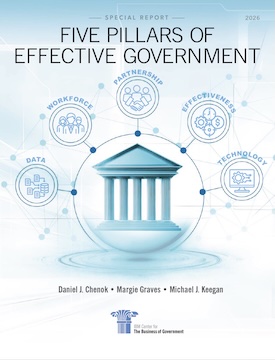
The IBM Center for The Business of Government has spent more than two decades informing leaders about effective practices for meeting these challenges, by grounding public-sector innovation in evidence, research, and real-world experience. Five Pillars of Effective Government advances that work by identifying five areas where meaningful progress can have the greatest impact—areas where the right ideas, the right tools, and the right leader-ship can strengthen the capacity of government to serve the nation.
This report is built around five central pillars:
- Multi-sector partnerships
- Financial and operational effectiveness
- Technology-enabled service and efficiency
- Data-driven decision-making
- A strong and modern government workforce
Individually, each pillar addresses a fundamental dimension of good governance. Together, they support a comprehensive strategic framework for delivering on what the public expects—and deserves—from its institutions: a government that works, responds, and earns trust through performance.